

Meta tags are a small part of a webpage’s code, but some of them play an important role in how your content is understood and presented in search results. A well-written title and meta description can clearly communicate what a page offers and encourage the right users to visit it.
A meta tags SEO generator makes this process easier by helping you create essential SEO metadata without manually writing HTML tags.
Whether you’re optimizing a blog post, business website, product page, or online store, understanding how meta tags work can help you build cleaner and more search-friendly pages.
In this guide, we’ll explain what meta tags are, which ones matter for SEO, how to create them, how meta keywords work today, and what Magento website owners should know about metadata.
What Are Meta Tags?
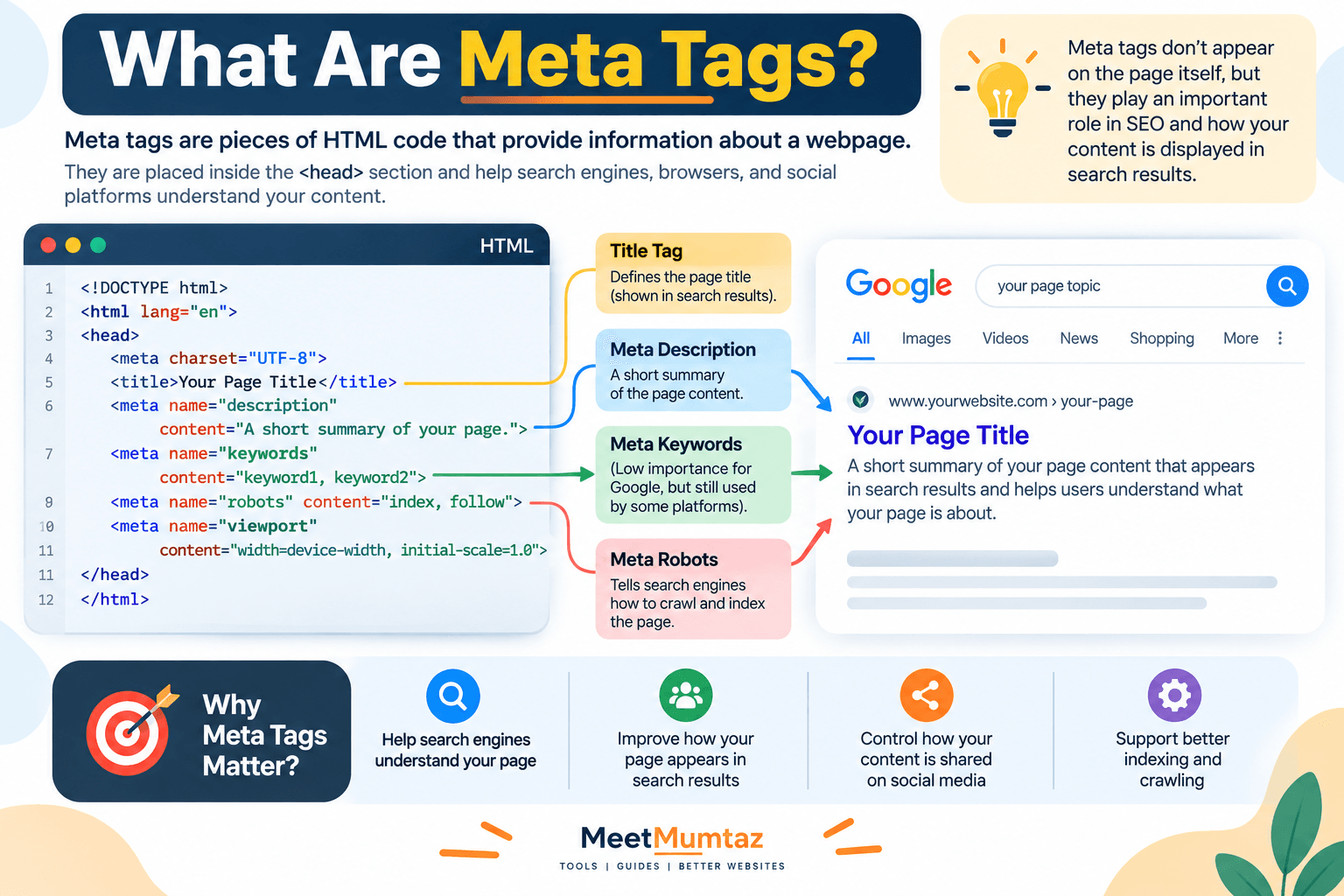
Meta tags are pieces of HTML metadata that provide information about a webpage.
Most meta tags are placed inside the <head> section of an HTML document. They aren’t normally displayed as part of the visible page content, but browsers, search engines, and other services can use the information they contain.
Common metadata includes:
- Page title
- Meta description
- Robots directives
- Character encoding
- Viewport information
- Social sharing metadata
For SEO purposes, the title and meta description are usually among the most familiar elements website owners optimize.
What Is a Meta Tags SEO Generator?
A meta tags SEO generator is a tool that helps create metadata for a webpage based on information you provide.
Instead of manually remembering HTML syntax, you can enter details such as your page title, description, keywords, or indexing preferences and generate the corresponding markup.
For example, a tool may help generate a title and description that can then be added to your website’s HTML or SEO configuration.
This is particularly useful for beginners, developers, bloggers, marketers, and website owners who regularly optimize multiple pages.
Why Are Meta Tags Important for SEO?
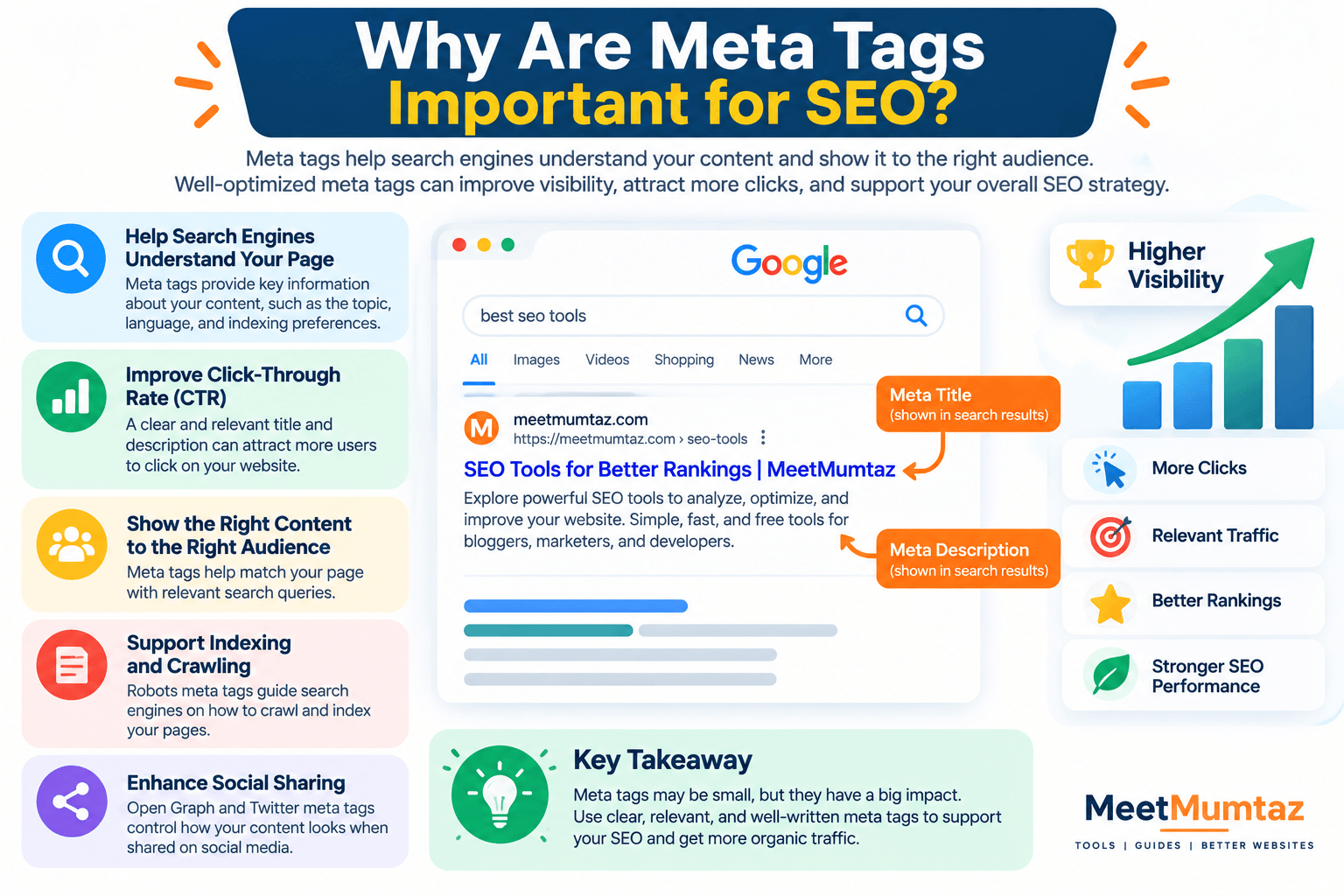
Not every meta tag directly influences rankings, but metadata can still have an important role in SEO and how pages are presented.
A clear page title helps communicate the primary topic of a webpage.
A useful meta description can provide searchers with a concise preview of what they’ll find after clicking.
Robots directives can tell compatible search engines whether a page should be indexed or whether certain crawling/indexing behaviors are preferred.
The important point is that meta tags should accurately represent the page.
Writing misleading metadata simply to attract clicks can result in a poor experience when visitors discover that the content doesn’t match their expectations.
What Is a Meta Tag Maker?
A meta tag maker is another name commonly used for a tool that creates HTML metadata.
Depending on the tool, you may be able to generate:
- SEO titles
- Meta descriptions
- Robots meta tags
- Author information
- Keyword fields
- Viewport tags
- Other HTML metadata
Some tools provide only the essential SEO fields, while others generate a larger collection of tags.
For most SEO projects, you should focus on metadata that serves a clear purpose rather than adding tags simply because a generator supports them.
How to Use a Meta Tags SEO Generator
Using a meta tag generator is usually straightforward.
First, identify the page you want to optimize and determine its primary topic or search intent.
Next, create a concise page title that accurately describes the content.
Write a meta description that explains what the visitor can expect from the page and gives them a reason to explore it.
Enter the information into the meta tags SEO generator, choose any additional options you need, and generate the markup.
Before adding the generated code to your website, review it carefully.
A generator can create the HTML structure, but the quality of the title and description still depends on the information you provide.
How to Write an Effective Meta Title
Your meta title should clearly communicate the page’s topic.
Try to place the main topic naturally within the title without stuffing it with variations of the same keyword.
A useful title generally combines three things:
Topic + Value + Context
For example:
Keyword Density Checker Tool – Analyze Keyword Usage
This tells users what the page provides without unnecessary repetition.
Avoid titles such as:
Best Keyword Tool | Keyword Tool | Free Keyword Tool | SEO Keyword Tool
Repeating similar phrases does not make a title more useful.
Keep it descriptive, relevant, and readable.
What Is a Meta Title Generator?
A meta title generator helps create or structure title ideas for webpages.
It can be useful when you’re struggling to turn a target keyword into a concise, compelling title.
However, generated titles should always be reviewed manually.
Ask yourself:
Does this title accurately describe my page?
Would a real person understand what they’ll get after clicking it?
Does the keyword fit naturally?
If the answer is yes, the title is probably heading in the right direction.
How to Write a Good Meta Description
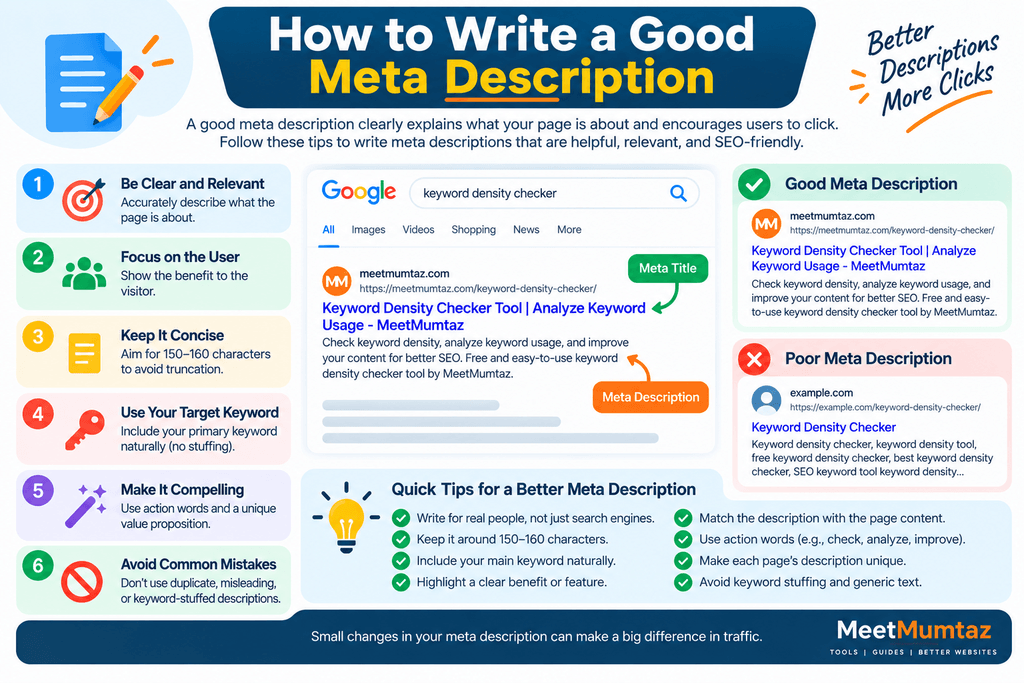
A meta description should summarize the page and encourage qualified users to visit it.
Rather than filling the description with keywords, explain the benefit of the page.
For example:
Create SEO-friendly meta tags for your webpages, including optimized titles and descriptions, with an easy-to-use meta tag generator.
This communicates the purpose naturally.
Search engines may sometimes display different text from the page instead of the description you provide, depending on the user’s query. For that reason, a meta description should be treated as a useful recommendation rather than a guaranteed search-result snippet.
What Are Meta Keywords?
Meta keywords are keywords placed inside the meta keywords HTML element.
Historically, website owners used this field to tell search engines which terms were associated with a webpage.
An example might contain terms related to the page’s subject.
However, the SEO landscape has changed significantly.
For modern Google SEO, you should not rely on the meta keywords tag as a way to improve rankings.
Instead, focus on using relevant terminology naturally within the actual content, headings, title, internal links, image context, and other meaningful page elements.
Are Meta Keywords Still Important for Google SEO?
For Google specifically, the traditional keywords meta tag is not something you need to optimize for web ranking purposes.
This is important because some older SEO checklists and website systems still display a field labeled Meta Keywords.
Seeing the field does not mean you need to fill it with dozens of search terms.
Your time is generally better spent improving:
- Page titles
- Content quality
- Search intent
- Meta descriptions
- Internal linking
- Technical SEO
- Structured content
- Website authority
Don’t confuse a legacy metadata field with your actual keyword strategy.
Meta Keywords vs. SEO Keywords
The terms sound similar, but they refer to different things.
Meta keywords refer specifically to the old HTML keywords field.
SEO keywords are the search terms and topics around which you research and optimize useful content.
Modern keyword optimization happens primarily through the content and structure of the page rather than by inserting a list into a meta keywords tag.
For example, if you’re targeting “meta tags SEO generator,” your page should genuinely explain or provide a meta tag generation solution.
Simply placing that phrase inside a keywords meta tag doesn’t accomplish the same thing.
What Are Meta Keywords in Magento?
Magento store owners may encounter metadata settings while optimizing categories, products, and other store pages.
Depending on the Magento version, configuration, extensions, and page type, administrators may see fields associated with metadata such as:
- Meta title
- Meta description
- Meta keywords
This sometimes leads merchants to assume that filling the meta keywords Magento field is essential for ranking products.
It isn’t a substitute for actual ecommerce SEO.
Your product and category optimization should prioritize useful titles, unique descriptions, search-friendly URLs, internal navigation, crawlability, canonicalization, structured product information, and high-quality content.
Magento Search Meta Keywords: What Should Store Owners Do?
If you’re researching Magento search meta keywords, distinguish between internal Magento functionality and search-engine optimization.
A field being available within a CMS doesn’t necessarily mean Google uses that field as a ranking signal.
For Magento SEO, focus on metadata that can meaningfully influence how pages are understood or presented, particularly page titles and descriptions.
More importantly, optimize the actual product or category page.
A strong ecommerce page should provide useful information about the product or category instead of depending on hidden keyword fields.
Meta Keywords Magento: Should You Fill the Field?
If your Magento installation provides a meta keywords field, don’t assume that filling it with every possible variation will improve Google rankings.
Avoid lists such as:
shoes, best shoes, cheap shoes, buy shoes, shoes online, online shoes, best online shoes
This approach adds little SEO value and can distract from more important optimization work.
Instead, identify the primary intent of each product or category page and optimize the elements users and search engines actually interact with.
Meta Tags vs. Open Graph Tags
Traditional SEO metadata and Open Graph metadata serve related but different purposes.
SEO metadata primarily helps describe pages for search and browser contexts.
Open Graph tags are commonly used to control how content is represented when shared on compatible social platforms.
Open Graph information may include:
- OG title
- OG description
- OG image
- OG URL
- Content type
A well-optimized website may therefore use both standard metadata and social sharing metadata.
They should complement each other rather than contain misleading or unrelated information.
Meta Tags vs. Schema Markup
Meta tags and schema markup shouldn’t be confused.
Meta tags provide metadata through HTML elements, usually within the page’s <head>.
Schema markup provides structured information that can help compatible search engines understand entities and page content more precisely.
For example, structured data can describe things such as:
- Articles
- Products
- Organizations
- Breadcrumbs
- Events
- Recipes
One does not replace the other.
A technically optimized webpage may use appropriate meta tags and relevant structured data together.
Common Meta Tag SEO Mistakes
One common mistake is stuffing the title with multiple variations of the same keyword.
Another is using identical titles and descriptions across many pages.
Website owners also sometimes create descriptions that don’t accurately reflect the actual page.
Other mistakes include excessively long titles, meaningless keyword lists, duplicate metadata, and blindly copying generated tags without reviewing them.
A meta tag maker should make implementation easier, but it cannot replace SEO judgment.
Always review generated metadata before publishing it.
Should Every Page Have Unique Meta Tags?
Important indexable pages should generally have metadata that accurately reflects their individual content.
Imagine an online store with 500 products using exactly the same title and description.
Search engines and users would have much less information for distinguishing one page from another.
Instead, create titles that describe the specific product, service, article, category, or resource.
Descriptions should also reflect what makes each page useful.
At scale, templates can help, but they should still produce meaningful page-specific information.
How Meta Tags Work With Search Intent
Before creating metadata, understand why someone would search for the topic.
A person searching for a meta tags SEO generator probably wants a practical tool for creating metadata.
Someone searching “what are meta keywords?” has informational intent.
A search for a particular ecommerce platform’s metadata settings may indicate a technical implementation problem.
These users shouldn’t necessarily receive identical titles and descriptions.
Matching metadata with search intent can make your search listing clearer and attract more relevant visitors.
Can a Meta Tags SEO Generator Improve Rankings?
A generator itself cannot guarantee rankings.
Its purpose is to make creating correctly structured metadata faster and easier.
Search performance depends on a much wider set of factors, including content relevance, technical accessibility, website authority, internal linking, backlinks, page experience, and how effectively the content satisfies search intent.
Think of a meta tags SEO generator as one tool within a broader SEO workflow.
It helps you implement metadata efficiently, while the overall quality of the page determines how useful that optimization becomes.
Frequently Asked Questions
What is a meta tags SEO generator?
A meta tags SEO generator is a tool that creates HTML metadata based on information such as a webpage’s title, description, indexing preferences, and other supported settings.
What is a meta tag maker?
A meta tag maker generates HTML meta tags without requiring you to manually write the markup. Depending on the tool, it may support titles, descriptions, robots directives, and other metadata.
What is a meta title generator?
A meta title generator helps create title ideas for webpages based on a topic or keyword. Generated titles should still be reviewed for relevance, accuracy, readability, and search intent.
Does Google use meta keywords?
Google has stated that it does not use the keywords meta tag in its web search ranking. Therefore, filling the field with large keyword lists shouldn’t be treated as a Google SEO strategy.
Should I use meta keywords in Magento?
If your Magento setup includes a meta keywords field, don’t rely on it for Google rankings. Prioritize page titles, descriptions, product/category content, technical SEO, internal linking, and other meaningful optimization elements.
What is the difference between a meta title and meta description?
The title identifies the page and is commonly used as an important title signal, while the meta description provides a short summary that search engines may use when creating a search-result snippet.
Can I automatically generate meta tags?
Yes. A meta tag generator can automatically create the required HTML structure after you enter your page information. You should still review the generated output before adding it to a live website.
Are meta tags enough for SEO?
No. Meta tags are only one part of SEO. Strong organic performance also requires useful content, appropriate site architecture, technical accessibility, internal links, authority, and alignment with search intent.
Final Thoughts
A meta tags SEO generator can save time and reduce the technical work involved in creating webpage metadata, but good SEO still requires human judgment.
Focus first on creating an accurate title and useful meta description. Use a meta tag maker to simplify the HTML implementation, and don’t rely on outdated meta keywords practices as a shortcut to rankings.
For Magento websites, the same principle applies: prioritize metadata and page elements that genuinely help users and search engines understand products and categories instead of stuffing the meta keywords Magento field.
The best metadata is simple, accurate, relevant, and written for the page it represents.
When those fundamentals are combined with useful content and solid technical SEO, meta tags become an effective part of a much stronger search optimization strategy.