

Using the right keywords is important for SEO, but simply repeating a keyword throughout your content does not guarantee better rankings. In fact, excessive repetition can make an article difficult to read and may result in keyword stuffing.
A keyword density checker tool helps you understand how frequently words and phrases appear within your content. Instead of guessing whether you have used a keyword too often or too little, you can analyze the text and make informed optimization decisions.
In this guide, you’ll learn what keyword density means, how to check it, what a good keyword density looks like, and how to use keyword frequency data to improve your content without sacrificing readability.
What Is Keyword Density?
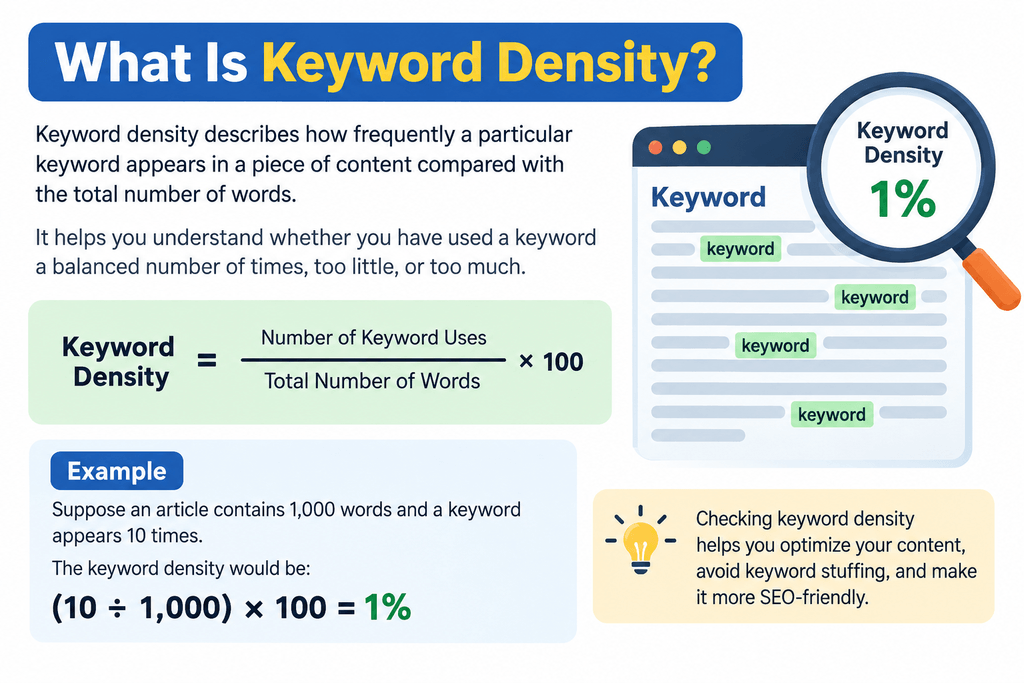
Keyword density describes how frequently a particular keyword appears in a piece of content compared with the total number of words.
For example, suppose an article contains 1,000 words and a particular keyword appears 10 times. Its keyword density would be approximately 1%.
The basic calculation is:
Keyword Density = (Number of Keyword Uses ÷ Total Number of Words) × 100
However, keyword density should not be treated as a ranking formula. Search engines have become much better at understanding context, topics, related terms, and search intent.
The purpose of checking keyword density is therefore not to achieve a magical percentage. It is to identify repetition, understand word usage, and improve the overall quality of your content.
What Is a Keyword Density Checker Tool?
A keyword density checker tool analyzes your content and shows how frequently individual words or phrases occur.
Depending on the tool, the report may include:
- Total word count
- Keyword frequency
- Keyword density percentage
- One-word phrases
- Two-word phrases
- Three-word phrases
- Frequently repeated terms
This information can help writers, bloggers, website owners, and SEO professionals quickly understand the keyword distribution of a page.
Instead of manually counting every occurrence, you can paste your content into a checker and review the results within seconds.
Why Is Keyword Density Important for SEO?
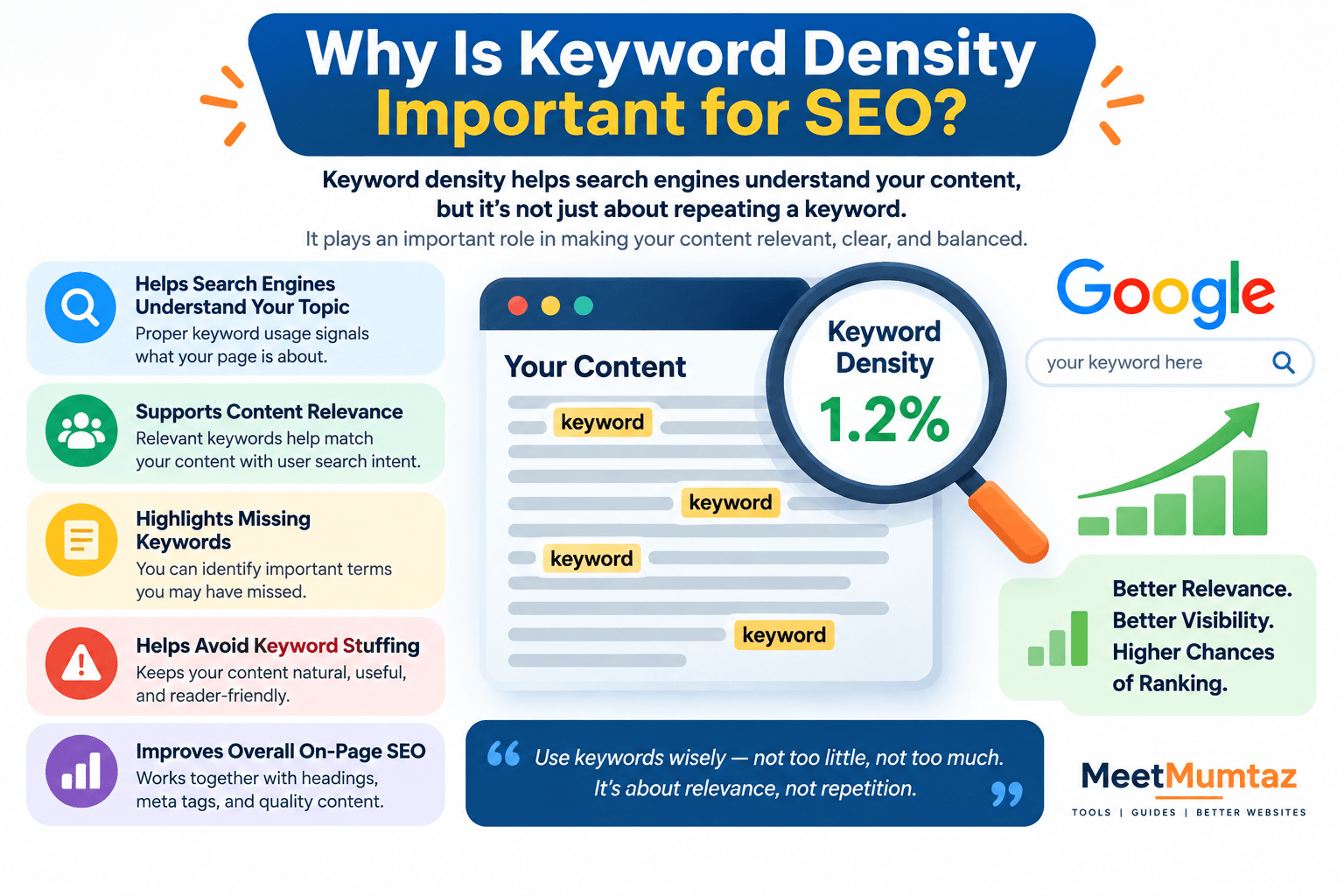
Keyword usage helps search engines understand what a page is about, but keywords need to appear naturally within useful content.
If an important topic is barely mentioned, the content may not communicate its focus clearly enough. On the other hand, repeating the same phrase unnecessarily can make the page sound unnatural.
Checking keyword frequency can help you identify both situations.
The goal is to create content that clearly covers the subject while still sounding as though it was written for people rather than an algorithm.
What Is a Good Keyword Density?
There is no universal ideal keyword density percentage that guarantees higher rankings.
You may encounter recommendations such as 1%, 2%, or another fixed percentage, but SEO should not be approached by forcing every article to meet the same number.
A better approach is to ask:
Does the keyword appear naturally where it helps readers and explains the topic?
Your primary keyword will often make sense in places such as the page title, introduction, relevant headings, body content, SEO title, and meta description. But it should only be included when it fits naturally.
If you have to rewrite awkward sentences simply to add another exact-match keyword, you are probably over-optimizing.
How to Use a Keyword Density Checker Tool
Checking keyword density is straightforward.
First, prepare the article, webpage copy, product description, or other text you want to analyze.
Next, enter or paste the content into the keyword density checker tool and start the analysis.
The tool can then identify frequently occurring words and phrases and calculate their percentage of the overall content.
Review the results carefully rather than focusing only on the highest percentage.
Look for keywords that appear too frequently, important terms that may be missing, and repeated phrases that could be replaced with more natural language.
Finally, edit your content and run the analysis again if necessary.
The objective isn’t to manipulate a percentage. It is to make your content clearer, more relevant, and easier to read.
Keyword Density vs. Keyword Frequency
Keyword density and keyword frequency are related, but they are not exactly the same.
Keyword frequency tells you the number of times a keyword appears.
Keyword density expresses that frequency as a percentage of the total content.
For example, using a keyword 10 times means its frequency is 10. If those 10 occurrences appear in a 1,000-word article, its density is approximately 1%.
Looking at both metrics gives you a better understanding of how words are distributed throughout a page.
Can Keyword Density Checker Tools Find Keyword Stuffing?
A checker can help identify possible overuse, but it cannot automatically determine whether every repeated keyword constitutes keyword stuffing.
Context matters.
For example, an article specifically explaining “SEO tools” may naturally mention that phrase several times. A high frequency alone does not prove that the content is poorly optimized.
Look for warning signs such as repetitive sentences, unnecessary exact-match phrases, keywords inserted where they do not belong, and paragraphs that sound unnatural when read aloud.
Use the report as a diagnostic aid rather than an automatic SEO verdict.
Should You Use Exact-Match Keywords?
Exact-match keywords can still be useful, particularly when they accurately describe the topic. However, you don’t need to repeat the exact same phrase throughout the entire article.
Search engines can understand related concepts and variations.
For a page targeting a keyword density checker, related language might naturally include terms such as:
keyword frequency, keyword count, word count, keyword analysis, SEO content analysis, repeated words, search terms, and content optimization.
Using relevant terminology helps you explain the subject more comprehensively while avoiding unnatural repetition.
What Keywords Should I Use When I Scan a Website?

A common question among website owners is: What keywords should I use when I scan a website?
Start with the page’s primary search intent.
Ask what someone would type into a search engine to find that specific page. Then identify one main keyword and several closely related terms that support the same topic.
When scanning existing content, look at:
- The primary topic of the page.
- Important words already appearing naturally.
- Search terms relevant to the user’s intent.
- Related phrases and subtopics.
- Words that are being repeated excessively.
Don’t add unrelated keywords simply because they have search volume. Every keyword should support the purpose of the page.
Keyword Count Checker vs. Keyword Density Checker
A keyword count checker primarily tells you how many times a word or phrase occurs.
A keyword density checker goes one step further by comparing that count with the total amount of content and expressing it as a percentage.
Both metrics are useful.
The count gives you the raw number of occurrences, while density makes it easier to compare keyword usage across articles of different lengths.
For example, 15 mentions of a keyword may be excessive in a 300-word page but much less significant in a 3,000-word guide.
How to Reduce Keyword Stuffing
If your analysis shows that a particular keyword appears excessively, don’t simply delete random occurrences.
Read the content naturally and identify repetitions that add no value.
You can improve the copy by replacing unnecessary exact matches with pronouns, synonyms, related terminology, or more descriptive sentences.
Sometimes the best solution is simply to remove the keyword entirely.
For example, instead of repeatedly writing:
“Use our keyword density checker tool to check keyword density with our keyword density checker tool.”
A natural version would be:
“Analyze your content to see how frequently important words and phrases appear.”
The second version communicates the same idea without forcing the target phrase.
Does Keyword Density Affect Google Rankings?
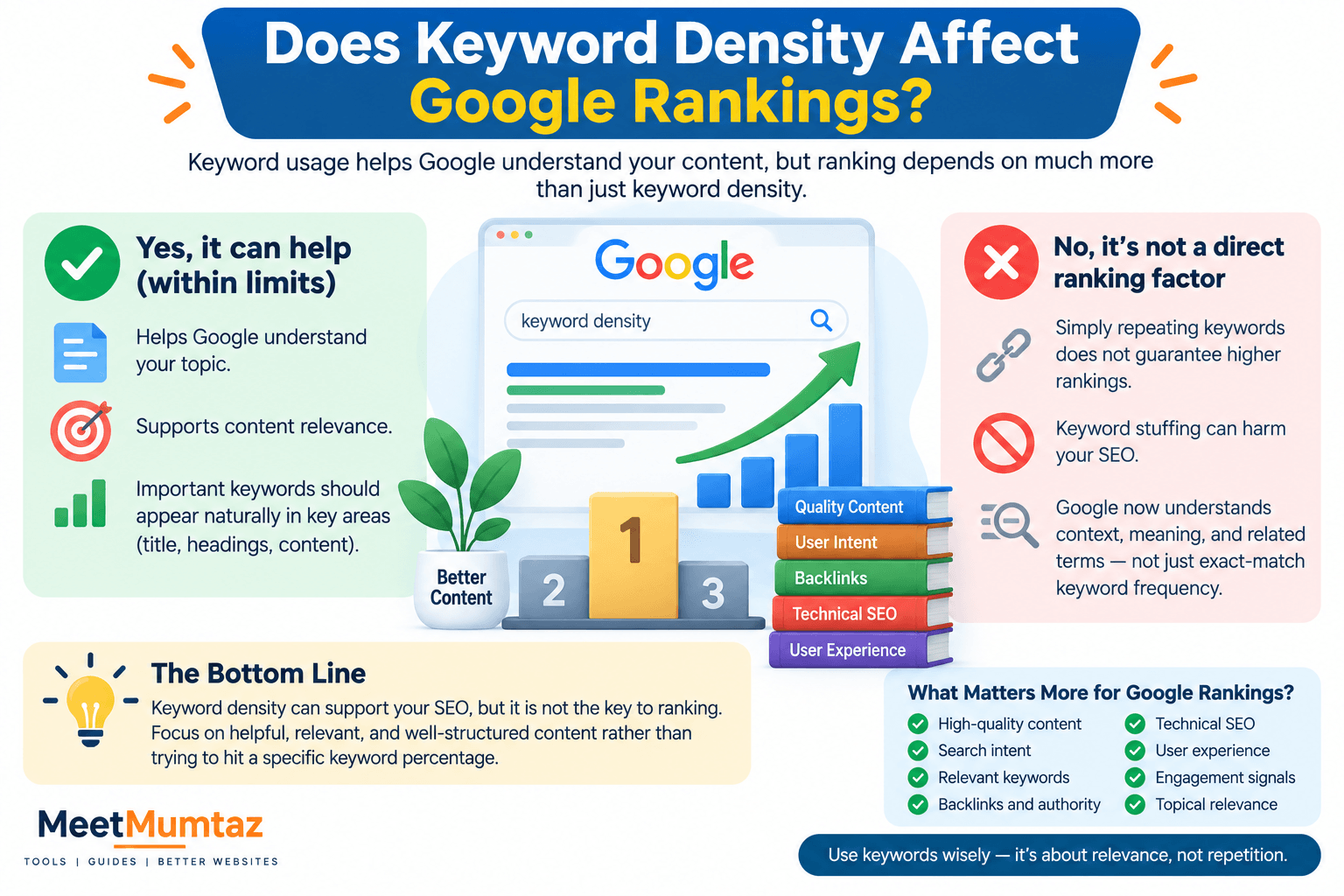
Keyword usage can contribute to the overall relevance of a page, but keyword density itself should not be treated as a standalone ranking factor or target percentage.
Modern SEO involves many interconnected elements, including:
- Search intent
- Content quality
- Topical relevance
- Internal linking
- Page structure
- Technical SEO
- Website authority
- User experience
- Backlinks
A perfectly calculated keyword percentage cannot compensate for thin or unhelpful content.
Focus first on satisfying the searcher’s needs. Use keyword analysis afterward to identify potential optimization issues.
Common Keyword Density Mistakes
One of the biggest mistakes is writing content around a predetermined percentage.
Another is repeating an exact-match keyword in nearly every paragraph because you believe more occurrences will automatically improve rankings.
You should also avoid adding keywords that don’t fit the search intent simply because an SEO tool recommends them.
Finally, don’t ignore readability.
If an article sounds robotic when you read it aloud, reducing keyword repetition will often improve it.
How to Optimize Content After Checking Keyword Density
Once you have analyzed the content, review more than just the percentage column.
Check whether your primary topic is clearly established near the beginning of the page. Review headings to ensure they accurately describe each section.
Look for excessive repetition and replace it where appropriate.
Then consider whether important related concepts are missing. Adding useful supporting information is generally better than repeating the same keyword again.
Your final content should feel comprehensive and natural.
Frequently Asked Questions
What does a keyword density checker tool do?
A keyword density checker tool analyzes text to determine how frequently specific words and phrases appear. It can help identify repeated keywords and understand how terms are distributed throughout your content.
Is 2% keyword density good for SEO?
Not necessarily. There is no fixed keyword density percentage that works for every page. A natural 0.8% may be perfectly appropriate for one article, while another topic may naturally require more frequent use of a particular term.
How many times should I use my primary keyword?
There is no fixed number. Use your primary keyword where it naturally helps establish the topic, and avoid inserting it merely to increase its frequency.
What is a keyword count checker?
A keyword count checker calculates how many times a particular word or phrase occurs within a piece of content. Keyword density additionally compares that count with the total number of words.
Can I check two-word and three-word keywords?
Yes. A useful keyword analysis can examine single words as well as two-word and three-word phrases, which can reveal repeated topics and phrase patterns that individual word counts may miss.
Can keyword density improve SEO?
Keyword analysis can help you improve content by identifying missing, excessive, or repetitive terms. However, achieving a specific density percentage does not guarantee higher search rankings.
Should I use related keywords?
Yes. Relevant variations and related terminology can help you cover a topic naturally and comprehensively without repeatedly forcing the same exact-match keyword.
Final Thoughts
A keyword density checker tool is most valuable when you use it to understand your content rather than chase a specific percentage.
Check keyword frequency, identify unnecessary repetition, review important phrases, and then optimize the content for clarity and search intent.
SEO content should ultimately answer the reader’s question.
Use keywords to make the topic clear, not to make the content repetitive. When useful information, natural language, technical optimization, and sensible keyword usage work together, you have a much stronger foundation for long-term organic search performance.